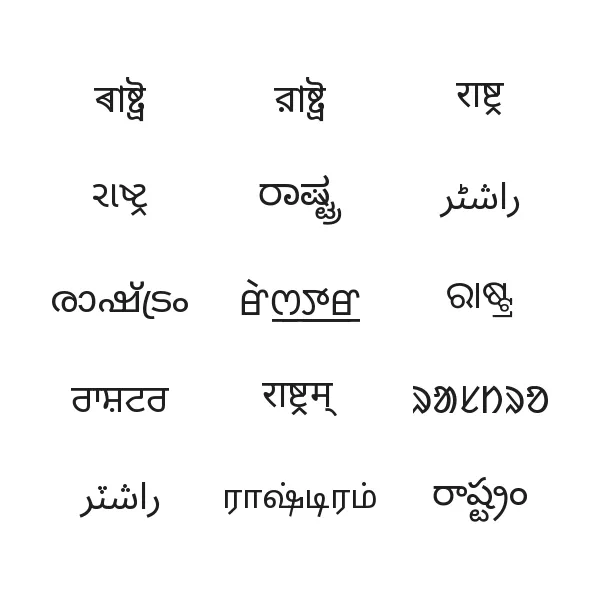
Who Needs a Government? Ancient Indian Theories on Origin of State
Today, as we celebrate India’s 80th Independence Day, we carry the dreams of those who fought for our freedom. Some of us are whitepilled (ambitious/optimistic), many are blackpilled (pessimistic) about the future of the Indian State. But what is the need of the state? How did it begin?
In academia, we are mostly taught about the origins of the state from an Ancient Greek point of view, while most of us remain ignorant about Ancient Indian ideas on the origins of the state. Two texts- Shanti Parva from the Mahabharata and Kautilya’s Arthashastra have talked about the origins of the state.
After the Kurukshetra war ended, Sri Krishna asked Yudhishtira to go to Bheeshma, who was lying on a bed of arrows, to learn about statecraft. Yudhishtira asked him about the origin of Rajya (the modern-day equivalent would be the state) and Rajan (the modern-day equivalent would be government).
Bheeshma says “नैव राज्यं न राजाऽऽसीत् न दण्डो न च दाण्डिकः।धर्मेणैव प्रजाः सर्वा रक्षन्ति च परस्परम्॥(Shanti Parva 59.12)”, which means there was a time (Krita/Satya Yuga) when there was no state, no king, no punishment, and no one to punish. People protected each other by following Dharma. This blog I found interprets it as “this early society as one without private ownership. Property was held in common, and human relations rested on mutual restraint and shared morality.”
But then, as time passed, people forgot the path of Dharma and were corrupted by lust, anger, and greed. Society became chaotic. They stopped following the Vedas and ceased to perform rituals or make offerings to the Devatas. The Devatas grew worried, as without the sacrifices made in Yajnas they would not be able to provide survival necessities like timely rain, good harvests, etc. They went to Brahma. Brahma then composed a treatise on topics like Dharma, Artha, Kama, and Moksha. It included the Dandaniti (or the science of punishments).
This was only theory, and theory can only take you so far. So the Devatas went to Vishnu and requested him to appoint a king. Viraja was instructed by Vishnu to take up this responsibility, but he declined it as he was more interested in attaining Moksha. Then his son Kirtiman and his grandson Kardama also refused. Then finally Kardama’s son Ananga accepted it and ruled according to Dharma. However, Ananga’s son Atibala and his grandson Vena became corrupted. The Rishis got frustrated with Vena’s rule and killed him using Mantra shakti (or the power of Mantras). From Vena’s right arm Prithu was born; he was skilled in statecraft and took guidance from the Devatas and upheld Dharma. Under his rule, the Earth’s surface became even, famines and diseases were rare, and there was no fear of reptiles or thieves. Seven types of crops were grown and everyone performed their duties. This indicates the emergence of a period of abundance. His governance earned him the title Rajan. Raja is defined as the one who pleases the people in the Mahabharata.
Another story can be found in Kautilya’s Arthashastra. As time passed, the situation of anarchy and injustice was back again, when “Matsya Nyaya” (rule of fish) prevailed. Matsya Nyaya refers to a state of a waterbody where bigger fish eat the smaller ones. To prevent this Matsya Nyaya, the state originated. To get out of this, Manu was given responsibility by Brahma to establish the rule of Dharma. Initially Manu was hesitant to take up the responsibility, as he feared sinful deeds and considered ruling a kingdom very difficult, especially because there are people who are always false and deceitful in their conduct. Then he was persuaded by the assurances and promises made by humans. Some of them included: he would be fulfilled with material resources, a tenth of the profits of his subjects as taxes, the sins committed by the subjects would not impact the Raja, and one fourth of the merit acquired by subjects under the Raja’s protection would belong to the Raja. And in return, he would protect the subjects from all wickedness and injustice, and restore Dharma.
Both theories attribute the origin of the state to the need to prevent Matsya Nyaya or the state of anarchy. So the state is there to do stability maxxing so that Dharma and other civilizational advancements can be made because of this stability.
There are some differences between Kautilya and Shanti Parva’s theory, though. Shanti Parva’s origin of Kingship is more centered on divine creation & cosmic order, while Kautilya’s is more focused on a pragmatic social contract. Probably Kautilya used the story of Manu as a tool for public propaganda to ensure obedience, rather than a theological claim of absolute divine right, as Kautilya did not really consider the King as some divine being and he focused a lot on the training of the King. Also, Kautilya has more to say about the State’s duty than just law and order the concept of Yogakshema, which means the security, peace, and material welfare of all citizens.
I plan to write more about Kautilya’s ideas later on, but yeah.
I want to conclude this blog by saying “वयं राष्ट्रे जागृयाम” (Yajurveda 9:23). We will keep the nation awake and alive, be alert, aware, and actively engaged in defending and uplifting our nation.
Bharat Mata ki Jai.
References:
[1]: Exploring the Origin of State in the Shantiparva
[2]: Theories of Origin of State in the Shanti Parva of Mahabharat: Part 1
[3]: The Hindu Theory of the State, BK Sarkar
[4]: Kauṭilya’s Arthaśāstra: Timeless Strategies for Modern Governance
I am open to any feedback or criticism on this post. I hope you liked this post. If you want to say Hi or anything, here’s my Telegram @ashirbadtele or you can mail me at ashirbadreal@proton.me.